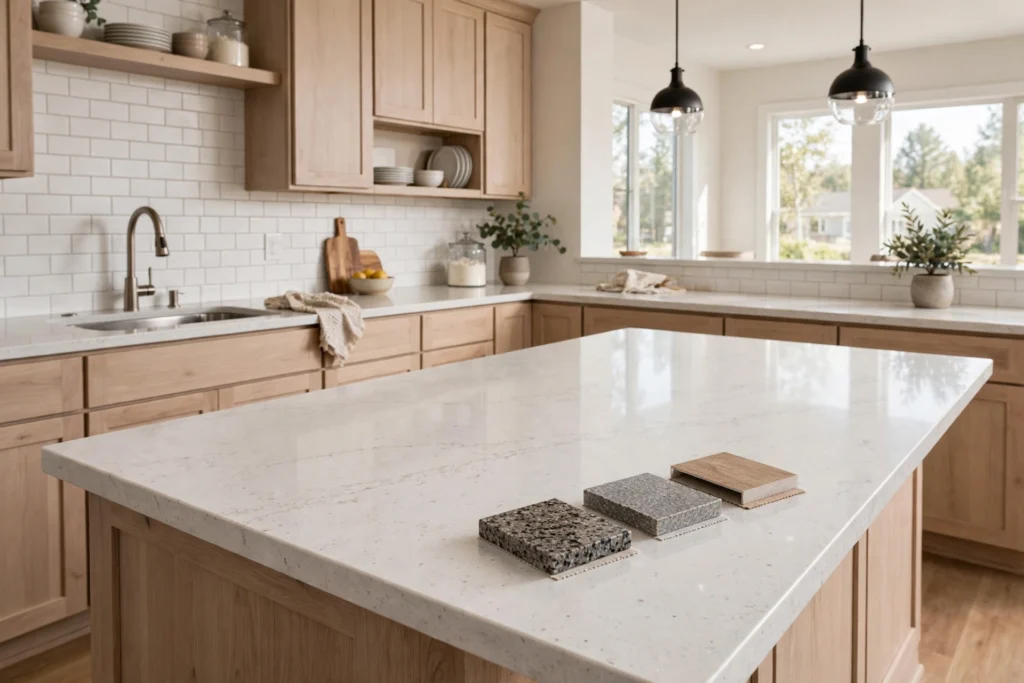
Updated October 2026. Replacing kitchen countertops can be a focused update or one of the biggest line items in a kitchen renovation. Angi’s current 2026 project data puts the national average countertop installation at about $3,160, with most projects between $1,882 and $4,484. HomeGuide’s broader material-based data places many installed countertops around $50 to $150 per square foot, with a typical 30- to 40-square-foot kitchen around $1,500 to $6,000.
The practical takeaway is that “countertop cost” can mean three different things: the slab or sheet material, fabrication and installation, or the full replacement project including demolition, sink and faucet work, backsplash, delivery, seams and cabinet corrections. Compare quotes only after you know which of those scopes each contractor is pricing.
Countertop replacement cost at a glance
| Project or material | 2026 planning range |
|---|---|
| Typical installed countertops | About $50–$150 per sq. ft. |
| Current national average project | About $3,160 |
| Most Angi 2026 projects | About $1,882–$4,484 |
| 30–40 sq. ft. kitchen | About $1,500–$6,000 |
| Laminate | About $20–$80 per sq. ft. installed |
| Granite | About $80–$150 per sq. ft. installed |
| Quartz | About $50–$200 per sq. ft. installed |
| Quartzite | About $65–$150 per sq. ft. installed |
| Porcelain | About $50–$120 per sq. ft. installed |
| Butcher block / wood | About $50–$150 per sq. ft. installed |
Current Angi data updated September 3, 2026 puts the national average countertop installation project at about $3,160, with most projects in its dataset between $1,882 and $4,484. HomeGuide reports a broader average of $50 to $150 per square foot installed and about $1,500 to $6,000 for 30 to 40 square feet. Using more than one dataset is useful because countertop projects vary dramatically in scope.
What determines the final price?
Countertop material
Material is usually the biggest visible choice, but the slab or sheet price is not the whole bill. Laminate can keep a project relatively economical, while natural stone, premium quartz, metal, specialty glass, and elaborate custom surfaces can move well above the typical range.
Do not compare two quotes only by the material name. One quartz line may be an entry-level color with straightforward fabrication while another uses a premium slab, waterfall edge, book-matched pattern, or multiple seams and cutouts.
Square footage and layout
More square footage means more material, but layout matters too. A compact L-shaped kitchen may be simpler to fabricate than a similarly sized kitchen with an island, peninsula, unusual angles, several appliance openings, and multiple seams.
For a rough measurement, countertop area is usually estimated in square feet. Professional fabricators should perform the final template because walls are rarely perfectly straight and appliance, sink, overhang, and seam clearances matter.
Removal and disposal
Some bids include demolition and disposal of the old counters; others list it separately. HomeGuide notes that old-counter removal may be included or charged separately. Before comparing bids, make sure both contractors are pricing the same scope.
Sink, faucet and cooktop work
Undermount sinks, cooktops, soap dispensers and faucets require cutouts or drilled holes. Plumbing may need to be disconnected before removal and reconnected after installation. A new sink or a change in sink dimensions can add both fabrication and plumbing costs.
If your project also involves replacing a disposal, compare that work separately rather than assuming it is included in the countertop bid. Our 2026 plumber cost guide can help you evaluate plumbing labor.
Edge profiles and backsplashes
A basic eased or square edge is often included in standard fabrication. More decorative profiles and mitered edges can add cost by the linear foot. A matching slab backsplash can also require considerably more material than a short standard backsplash.
Cabinet condition
New countertops need a sound, level base. If cabinets are loose, damaged, out of level, or unable to support a heavy surface, reinforcement or cabinet work can become a hidden cost. This is particularly important when switching from a lightweight countertop to stone or concrete.
Cost by common countertop material
Laminate
Laminate remains one of the lowest-cost ways to change the look of a kitchen. HomeGuide reports roughly $20 to $80 per square foot installed across laminate products, with Formica-branded installations commonly around $20 to $60 per square foot. It can be a sensible choice for a budget renovation, rental, or kitchen where the cabinets may be replaced later.
Granite
Granite commonly costs about $80 to $150 per square foot installed, according to HomeGuide, though simpler or premium projects can fall outside that band. Slab grade, thickness, pattern, number of seams, edge treatment, and cutouts all affect the quote.
Quartz
Engineered quartz spans a wide price range. HomeGuide currently reports about $50 to $200 per square foot installed. Premium colors, thick or mitered edges, large islands, and complex fabrication can make a quartz job substantially more expensive than a basic installation.
Butcher block and other wood
Wood counters can bring warmth to a kitchen but require maintenance and careful protection from standing water. Installed pricing commonly overlaps mid-range countertop materials. Ask specifically about finish, seam construction, sink-area protection, and maintenance requirements.
How kitchen size changes the budget
Square footage is still the fastest way to build a first-pass budget, but it should be used as a planning tool rather than a final measurement. HomeGuide’s current 2026 ranges provide a useful size-based framework:
| Kitchen / counter size | Typical installed planning range |
|---|---|
| 20–30 sq. ft. of countertop | About $1,000–$4,500 |
| 30–40 sq. ft. of countertop | About $1,500–$6,000 |
| 40–60+ sq. ft. of countertop | About $6,000–$9,000+ for many larger projects |
A large kitchen does not automatically cost more per square foot, but it increases slab quantity, seam planning and the chance that multiple slabs will be required. Islands, waterfalls and large uninterrupted runs can also create expensive slab-yield problems even when the measured square footage looks ordinary.
How to estimate countertop square footage before getting quotes
- Measure the length and depth of each rectangular countertop section in inches.
- Multiply length by depth to get square inches.
- Add all sections together.
- Divide the total by 144 to estimate square feet.
- Use that number only for budgeting; let the fabricator create the final template before any slab is cut.
Do not subtract the sink or cooktop opening when building a rough homeowner budget. Fabricators often charge for the material and the cutout work even though the removed piece is not part of the finished surface. Also remember that slab yield, seam placement and pattern matching can require more purchased material than the finished square footage.
Do you need a permit?
A simple like-for-like countertop replacement often does not require a building permit by itself, but local rules control. Once the project changes plumbing, electrical work, structural support, walls, or other regulated systems, permits and inspections may apply. Check with your local building department rather than relying on a national rule.
If the counters are one part of a larger renovation, our kitchen remodel cost guide provides a broader budgeting framework.
A safety issue homeowners should not ignore: silica dust
Natural and engineered stone fabrication can create respirable crystalline silica when slabs are cut, ground, drilled, or polished. OSHA reiterated in July 2026 that manufacturing, finishing, and installing natural and engineered stone countertop products can expose workers to silica dust, which can cause serious disease. OSHA highlights controls such as wet methods, local exhaust ventilation, and process isolation.
For a homeowner, the practical lesson is simple: stone fabrication is not a casual indoor DIY cutting job. Ask your fabricator how cutting and finishing will be handled and avoid creating uncontrolled stone dust inside the home.
DIY vs. professional installation
Some prefabricated laminate or butcher-block projects can be reasonable DIY work for an experienced homeowner with the right tools and a simple layout. The financial attraction is obvious: professional installation labor can account for a meaningful share of the project.
Slab stone and large engineered surfaces are different. They are heavy, brittle, difficult to move safely, and require precise templating and fabrication. Mistakes can destroy an expensive slab or damage cabinets. Professional installation is usually the more sensible choice for quartz, granite, marble, large-format porcelain, and complicated layouts.
Repair the old counter or replace it?
Replacement is not always the first answer. Angi’s September 2026 countertop repair data puts many repairs around $100 to $800, compared with roughly $1,900 to $4,500 for replacement. Small chips, localized damage, minor seam issues, and some burns or stains may be repairable depending on the material.
Replacement becomes more attractive when damage is widespread, the substrate has significant water damage, the layout needs to change, the existing surface cannot be repaired acceptably, or the counters are being coordinated with a larger kitchen renovation.
Four realistic homeowner scenarios
Budget refresh
A homeowner keeps sound cabinets, chooses laminate, retains the existing sink location, and uses a standard edge. This minimizes fabrication, plumbing changes, and structural work and is the kind of project most likely to stay toward the lower end of the range.
Typical mid-range replacement
A 35-square-foot kitchen receives a mainstream quartz or granite surface, one sink cutout, standard edges, old-counter removal, and basic plumbing reconnection. A several-thousand-dollar budget is more realistic than multiplying a slab advertisement by the measured square footage.
Large island upgrade
A homeowner wants a large stone island with a wide overhang and an undermount sink. The quote may need to address slab yield, seam placement, cabinet or bracket support, sink mounting, edge treatment, and plumbing—not just square footage.
Countertops during a full remodel
If cabinets, sink location, outlets, backsplash, flooring, and appliances are all changing, countertop installation becomes one phase of a coordinated project. In that situation, compare the total kitchen scope rather than trying to optimize the counter price in isolation.
How to compare countertop quotes
Ask each contractor to quote the same material, thickness and scope. A useful written proposal should clarify:
- material manufacturer, color or slab selection;
- measured or estimated square footage;
- fabrication and installation;
- edge profile;
- number and location of seams where known;
- sink, faucet and cooktop cutouts;
- old-counter removal and disposal;
- backsplash, if included;
- plumbing or electrical disconnect/reconnect;
- cabinet leveling or reinforcement assumptions;
- delivery charges;
- sealing, where applicable;
- warranty and what it covers.
A quote that appears hundreds of dollars cheaper may simply exclude demolition, plumbing, sink mounting, delivery, or another item included by the competing contractor.
Hidden costs to budget for
Keep a contingency for problems discovered after the old surface comes off. Water-damaged cabinet tops, unlevel cabinet boxes, deteriorated sink plumbing, a sink that no longer fits, unexpected wall repair, backsplash damage, or appliance clearance problems can all change the final bill.
Also confirm whether the countertop company handles plumbing and electrical work itself or expects you to schedule licensed trades separately. Coordinating those trades can affect both cost and how long the kitchen is unusable.
Five-step countertop buying plan
- Choose the budget tier first. Decide whether the goal is an economical refresh, a mid-range durable surface, or a premium design statement before visiting slab yards.
- Measure for planning. Estimate countertop square footage, then note islands, sink type, cooktop openings, overhangs and backsplash plans.
- Check the cabinets. Confirm that the boxes are sound, level and ready to support the proposed material before final templating.
- Compare complete scopes. Put material, fabrication, edges, cutouts, demolition, disposal, plumbing, delivery, installation and sealing on the same comparison sheet.
- Approve the final template and slab details. Before fabrication, confirm seam locations, edge profile, sink reveal, overhangs, backsplash height and any pattern direction that matters.
Common countertop budgeting mistakes
- Comparing a slab-only advertisement with a fully installed contractor quote.
- Assuming every quartz, granite or marble product costs about the same.
- Ignoring demolition, disposal, plumbing disconnect/reconnect and sink mounting.
- Choosing a large waterfall island without considering how many slabs it consumes.
- Ordering a sink after the countertop has already been templated.
- Failing to check whether cabinets are level and structurally sound.
- Assuming a backsplash is included because the countertop material matches it.
- Approving stone fabrication without understanding where cutting and dust-producing work will occur.
What to verify before installation day
- The final material, color, slab or product line matches the signed order.
- Sink, faucet, cooktop and other cutout specifications are available to the fabricator.
- Old-counter removal responsibility is clear.
- Plumbing and electrical disconnects are scheduled if the countertop crew does not perform them.
- Cabinets are empty where required and access paths are clear.
- Any appliance that must fit under or beside the new surface has been measured.
- You know which wall, paint or backsplash repairs are excluded from the countertop contract.
Frequently asked questions
How much do new countertops cost in 2026?
The current national average project is about $3,160, while many projects fall between roughly $1,882 and $4,484. A 30- to 40-square-foot kitchen often ranges from about $1,500 to $6,000, depending on material and fabrication.
Is quartz more expensive than granite?
Not always. Current installed ranges overlap substantially: quartz commonly runs about $50–$200 per square foot, while granite is often about $80–$150. Slab grade, color, thickness, fabrication and layout determine which is more expensive on a specific project.
Can I replace countertops without replacing cabinets?
Yes, if the existing cabinets are structurally sound, level and compatible with the new surface. Cabinet repair, reinforcement or leveling may be needed before heavy stone or engineered slabs are installed.
Should I repair or replace damaged countertops?
Localized chips, burns, seam issues or small damaged areas can sometimes be repaired for far less than full replacement. Replacement is more compelling when damage is widespread, the substrate is compromised, the layout is changing or the old surface no longer fits the renovation plan.
Related Home Cost Desk guides
- Kitchen Remodel Cost 2026
- Kitchen Cabinet Refacing Cost 2026
- Dishwasher Installation Cost 2026
- Plumber Cost 2026
- How to Hire a Home Contractor in 2026
What to prepare before asking for countertop quotes
- Approximate countertop square footage
- Photos of the current counters, cabinets and sink area
- Preferred material and one backup option
- Sink model and whether it is undermount, drop-in or farmhouse style
- Cooktop dimensions if a cutout is required
- Desired edge profile and backsplash height
- Whether old-counter removal and disposal are needed
- Any cabinet damage, unevenness or water staining you already know about
Giving every bidder the same information makes the quotes much easier to compare and reduces the chance that a low initial estimate grows through change orders.
What to verify after installation
- Seams are finished as agreed and the surface sits level and stable.
- Sink mounting and cutouts match the approved template.
- Overhangs and supports match the quoted design.
- Backsplash joints, wall gaps and caulk lines are complete where included.
- Plumbing has been reconnected and checked for leaks if that work was part of the scope.
- You receive care, sealing and warranty instructions for the exact material installed.
Bottom line
For 2026 planning, $50 to $150 per square foot installed is a useful broad benchmark for many countertop projects, while current Angi data puts the national average around $3,160 and most projects around $1,882 to $4,484. An average 30- to 40-square-foot kitchen can reasonably span about $1,500 to $6,000, with premium materials and complex fabrication going higher.
The best way to control cost is not simply to choose the cheapest material. Keep the layout simple where possible, compare identical scopes, understand what demolition and trade work are excluded, and make sure the cabinets are ready to receive the new surface before fabrication begins.
Home Cost Desk compares current U.S. cost or technical references and checks safety, code, efficiency, incentive, or regulatory claims against authoritative sources when available. National figures are planning ranges, not local quotes.
Editorial review: Home Cost Desk Editorial Team · Read our research methodology · Detailed sources appear below.
Sources and methodology
Home Cost Desk uses national figures as planning benchmarks, not guaranteed local prices. This guide cross-checks current 2026 Angi project data with HomeGuide material and installation ranges. Safety guidance is based on current U.S. Occupational Safety and Health Administration information. Local contractor pricing, slab availability, taxes, access, fabrication complexity, and permit requirements can materially change a homeowner’s actual quote.