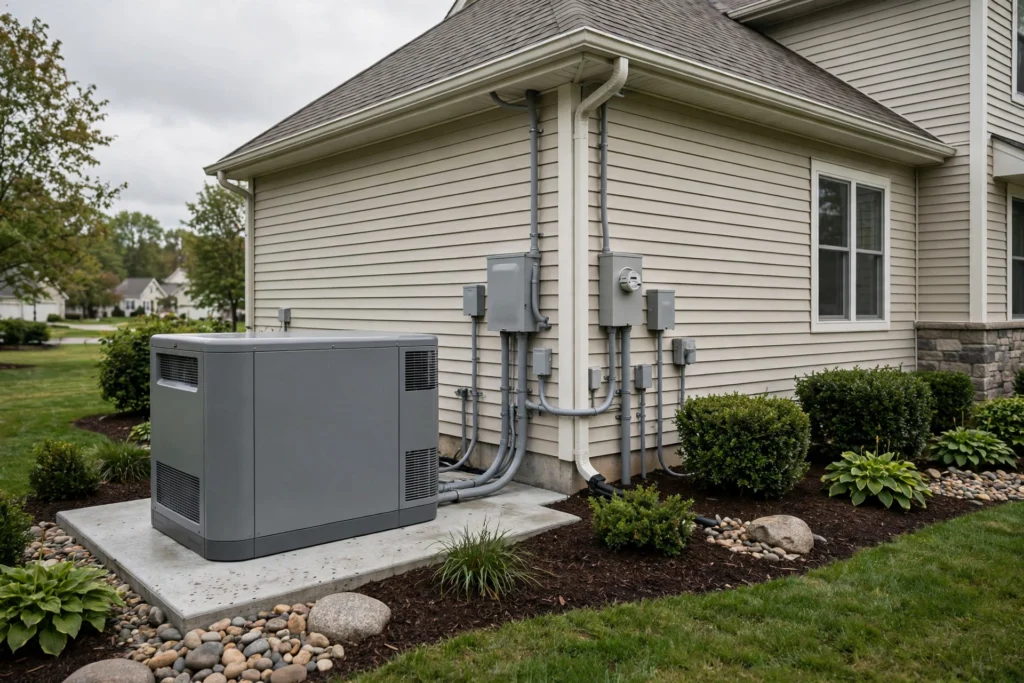
Updated October 2026. A whole-house generator can turn a long outage from an emergency into an inconvenience, but the installed price is much more than the generator on the showroom floor. Current 2026 data shows two useful planning benchmarks: Angi reports an average whole-house generator project of about $5,157, with most verified projects between $1,512 and $8,803, while HomeGuide places many fully installed whole-house systems around $6,000 to $11,000. Larger systems, long electrical or gas runs, major trenching, propane-tank work, or projects above roughly 20 kW can push the total toward $9,500 to $24,000 or more.
The apparent gap between national averages is mostly about scope. Some datasets include smaller essential-load standby projects; others reflect full-home systems with transfer switches, pads, gas work and more installation labor. The practical budgeting rule is to separate generator equipment from everything required to install and operate it safely at your house.
This guide focuses on permanently installed standby systems—not a portable generator sitting in a garage. If you are comparing bids, the useful question is not simply “How much is the generator?” It is “What will it cost to deliver the backup loads I actually need, safely and legally, at my house?”
Whole-house generator cost at a glance
| Project or component | Typical 2026 planning range |
|---|---|
| Portable generator (equipment only) | About $500–$2,500 |
| Whole-house standby generator (unit only) | About $3,000–$6,000 for many common systems |
| Whole-house generator installed | About $6,000–$11,000 for many typical projects |
| Large / complex installed project | About $9,500–$24,000+ |
| Automatic transfer switch installation | About $600–$2,500 |
| Concrete or equipment pad | About $150–$400 |
| Gas-line work | Often priced by distance and pipe size; long runs can add thousands |
| Propane tank installation, if required | About $400–$1,800 |
| Permits | About $80–$450 in many markets |
| Professional scheduled maintenance | About $171–$395 per service |
These are national planning figures, not a quote. Current 2026 ranges were cross-checked against Angi and HomeGuide. Local labor, code, trenching, fuel work, utility coordination, generator size and site access can move the total substantially.
What drives the installed price?
1. Generator capacity
A generator sized for a refrigerator, lights, furnace blower and sump pump is a different project from one expected to start central air conditioning, an electric water heater, well pump and multiple kitchen loads at the same time. Larger capacity raises equipment cost, but oversizing also means paying for output you may rarely use. Ask the installer for a written load calculation and a list of the circuits or appliances the proposed system will support.
2. Automatic transfer equipment
A standby system normally uses transfer equipment to isolate the home from the utility and transfer selected loads to generator power. The electrical configuration, service size and whether a subpanel or load-management controls are needed can materially affect labor and parts. This is one reason two homes buying the same generator can receive very different installed quotes.
3. Natural gas or propane work
Fuel infrastructure is often the hidden variable. A nearby, adequately sized natural-gas supply may make the job straightforward. A long run, undersized gas service, new propane tank, regulators or trenching can add cost. Have the quote identify fuel-system work separately rather than assuming it is included.
4. Site preparation and placement
The unit needs an approved location and base. Distance from the electrical service and fuel source, grading, concrete or composite pad requirements, landscaping restoration and difficult access all affect labor. Placement must also satisfy the manufacturer’s instructions and applicable local codes.
5. Permits and local requirements
Permanently installed standby generators commonly require electrical and/or other local approvals. Requirements vary by jurisdiction, so confirm who pulls permits, who arranges inspections and whether those charges are included in the proposal.
Hidden costs that can change a generator quote
The generator itself is often only half the budgeting problem. Ask about these items before comparing totals:
- Long electrical runs: conduit, conductors and trenching can add substantial labor and material cost.
- Gas-line upgrades: the existing line or meter may not have enough capacity for a large standby unit.
- Propane storage: a new tank, regulators, delivery access and pad can become a separate project.
- Automatic transfer switch: current national planning ranges often run about $600–$2,500 installed.
- Concrete or composite pad: site grading and the equipment base may add a few hundred dollars or more.
- Panel or subpanel work: older or crowded electrical equipment can expand the electrical scope.
- Landscaping restoration: trenching may disturb lawn, irrigation, hardscape or planting beds.
- Noise and placement constraints: local setbacks or noise rules can force the unit farther from the panel or gas meter.
- Utility coordination: some installations need gas-meter or electrical-service work beyond the generator contractor’s basic scope.
A strong estimate should either include these items or state clearly that they are excluded. The most dangerous budget assumption is that “installed price” means the same thing on every bid.
Three realistic 2026 generator budgets
Scenario 1 — Essential-load standby: The homeowner wants refrigeration, lights, internet, a gas-furnace blower and sump pump. A smaller standby unit, limited transfer setup and short fuel/electrical runs might land around $5,000–$8,000 installed. The important question is whether the proposal clearly lists the circuits that will be backed up.
Scenario 2 — Typical whole-home comfort: The family wants refrigeration, lighting, most receptacles, a gas furnace or one central air-conditioning system, kitchen loads and normal household use during a multi-day outage. A roughly 17–25 kW system with automatic transfer equipment commonly pushes the project toward about $7,000–$13,000, depending on HVAC starting loads, gas work and site layout.
Scenario 3 — Large or all-electric home: Multiple HVAC systems, electric water heating, a well pump, electric cooking, pool equipment or other high-demand loads can require a larger generator or aggressive load management. With a larger unit, long trenching, propane storage or upgraded fuel delivery, a project can reach roughly $12,000–$24,000+.
These examples are budgeting models, not quotes. They show why a homeowner should compare systems by the loads they will actually support rather than by generator brand or headline kilowatt number alone.
Standby generator vs. portable generator
A portable generator can cost far less upfront and may be sensible for occasional outages when only a few critical loads need power. A permanently installed standby unit offers automatic operation and can support more of the home, but adds transfer equipment, installation, permits, fuel connections and ongoing maintenance.
The choice is therefore not simply “cheap versus expensive.” Consider outage frequency, whether someone can safely set up and refuel portable equipment, critical medical or sump-pump loads, heating/cooling needs, noise, fuel storage and how much automation you value.
Ongoing fuel and maintenance costs
The purchase price is only the first cost. A standby generator needs periodic exercise, inspection and scheduled service so it is ready when the utility fails. Angi’s September 2026 maintenance data places many professional tune-up visits around $171–$395 per service. Larger liquid-cooled units and systems with more accessories can cost more to maintain.
Fuel cost depends heavily on generator size, load, run time and local natural-gas or propane pricing. HomeGuide’s 2026 planning data shows that a whole-home generator running continuously can consume enough fuel to cost from tens to well over one hundred dollars per day. Treat those numbers as scenario estimates, not guaranteed operating costs; a generator under partial load may consume much less than one running a large home near capacity.
For budgeting, ask the installer for fuel-consumption data at both 50% and 100% load for the exact model being proposed. That gives you a far more useful outage-cost estimate than a generic national average.
What should you actually back up?
Many homeowners save money by deciding which loads matter most before asking for bids. Start with four groups:
- Life and safety: medical equipment, well pump, sump pump, alarm systems and essential lighting.
- Food and communications: refrigerator, freezer, internet equipment and phone charging.
- Climate control: furnace blower, heat pump, mini split or central air conditioning.
- Convenience loads: cooking, laundry, pool equipment, EV charging and other high-demand appliances.
If the last group makes the generator dramatically larger, ask whether load management can temporarily prevent several high-demand appliances from running at the same time. That can lower equipment size without sacrificing the loads that actually matter during an outage.
DIY vs. professional installation
Homeowners can do useful planning themselves: list critical appliances, gather utility bills, locate the electrical panel, identify fuel availability and decide what absolutely must run during an outage. Permanent generator installation, however, involves electrical service and often gas or propane work. Those are not good places to learn by trial and error. Use appropriately licensed professionals for the work required in your jurisdiction and insist on permits and inspections where required.
Generator safety is not optional
The U.S. Consumer Product Safety Commission warns that generator exhaust contains carbon monoxide, a colorless and odorless gas that can kill within minutes. For portable fuel-powered generators, CPSC’s 2026 guidance says to operate them outdoors only, at least 20 feet from the home, with exhaust directed away from windows, doors and vents. Never run one in a house, garage, basement, crawlspace, shed, porch or carport—even with doors or windows open.
Current federal safety guidance is consistent on the essentials. The CDC says portable generators should be operated outdoors more than 20 feet from windows, doors and vents, and recommends a battery-powered or battery-backup carbon-monoxide detector in the home. The CPSC likewise says to keep portable generators at least 20 feet from homes and buildings, direct exhaust away from openings, and follow manufacturer instructions to reduce electrical-shock hazards in wet weather.
How to compare contractor quotes
Get multiple itemized bids for the same backup objective. A cheap quote is not comparable if it powers fewer loads or excludes work another contractor includes. Ask each bidder to show:
- generator make, model, rated capacity and warranty;
- the load calculation and exactly what the system is intended to power;
- transfer switch and load-management equipment;
- pad and site preparation;
- electrical labor and any panel/subpanel work;
- natural-gas or propane work and trenching;
- permits, inspection fees and startup/commissioning;
- maintenance requirements and first-year service, if offered;
- what is explicitly excluded from the quoted total.
If your electrical service is already near its limits, read our 2026 electrical panel upgrade cost guide before assuming the generator quote is the entire electrical budget. If your priority is keeping heating and cooling available during outages, our HVAC replacement cost guide helps put that major load—and its replacement budget—in context.
When is a whole-house generator worth it?
The economics are strongest when outages are frequent or long, loss of power creates a meaningful property risk, or automatic backup has real value to the household. A sump pump, well pump, refrigeration, home medical equipment or climate control can make reliable backup more than a convenience. In an area with rare, brief outages, a smaller essential-load solution may deliver better value.
Do not assume a generator “pays for itself” through resale value. Treat it first as resilience equipment. The financial decision is whether the installed and maintenance cost is justified by the disruption, damage risk and comfort it prevents for your household.
Five-step generator buying plan
- List the loads you cannot lose. Write down refrigeration, sump or well pump, heating/cooling, medical equipment, communications and other true priorities.
- Get a load calculation. Have the contractor show both running and starting demand, especially for air conditioners, heat pumps and pumps.
- Choose the fuel strategy. Confirm whether natural gas has adequate capacity or whether propane storage, regulators or trenching will be required.
- Compare complete installed scopes. Put equipment, transfer switch, pad, electrical work, fuel work, permits, trenching, restoration and commissioning on the same comparison sheet.
- Budget for ownership. Add scheduled maintenance and a realistic fuel-cost scenario for the length of outage you are trying to protect against.
Common generator budgeting mistakes
- Comparing generator sticker prices instead of installed project totals.
- Sizing from house square footage without accounting for starting loads.
- Assuming the existing gas line or meter can support the proposed unit.
- Paying for every circuit when load management could reduce generator size.
- Ignoring trenching, landscaping repair, propane storage or utility work.
- Choosing a location before checking manufacturer clearances and local rules.
- Forgetting maintenance and fuel when comparing long-term cost.
- Assuming a portable-generator safety rule automatically defines standby-generator placement. Permanently installed standby equipment must follow the manufacturer’s listing, installation instructions and applicable local code.
Before you sign
A sound proposal should answer three questions clearly: What will this system power? What is included in the installed price? What must happen before it can legally and safely operate? If the contractor cannot answer those in writing, keep shopping.
Final contractor checklist
- Exact generator model and rated output
- Written load calculation and supported loads
- Transfer switch and load-management equipment
- Natural-gas or propane scope
- Pad, trenching and site restoration
- Electrical panel or subpanel changes
- Permits and inspections
- Startup and commissioning
- Equipment and labor warranties
- Maintenance schedule and first service cost
Frequently asked questions
How much does a whole-house generator cost installed in 2026?
Many typical systems land around $6,000–$11,000 installed. Smaller essential-load projects may cost less, while large or complex installations can reach roughly $9,500–$24,000+.
Is a 22 kW generator enough for a whole house?
It can be for many homes, but there is no universal answer. HVAC starting load, electric water heating, well pumps, cooking equipment and other simultaneous loads matter more than square footage alone.
Does a whole-house generator need an automatic transfer switch?
Standby systems normally use listed transfer equipment so the home is safely isolated from utility power and selected loads transfer automatically. The exact configuration depends on the electrical service and system design.
How much should I budget for generator maintenance?
Current 2026 national data puts many professional scheduled service visits around $171–$395. The exact schedule and cost depend on the model, operating hours and manufacturer requirements.
Should I buy a larger generator just in case?
Not automatically. Oversizing increases equipment and fuel cost. A properly calculated smaller system with load management may deliver better value if it protects the loads you actually need.
Homeowner checklist before installation day
- Confirm the final generator model and transfer-switch model match the signed proposal.
- Know which circuits or appliances will be backed up and which will not.
- Confirm the fuel source, gas-line or propane scope and who is responsible for each part.
- Verify that permits and required inspections have been arranged.
- Clear safe access to the electrical panel, generator location and trench route.
- Document irrigation lines, landscaping or hardscape that could be disturbed.
- Ask when utility interruption, gas work or inspection could affect household service.
What to verify after installation
- The system starts automatically during a supervised test.
- The transfer switch moves the intended loads correctly.
- High-demand appliances behave as expected under the proposed load-management strategy.
- The installer explains shutdown, emergency procedures and manual controls.
- You receive permits or inspection records where applicable.
- You receive model numbers, warranty documents and the maintenance schedule.
- You know who to call if the generator fails to exercise or shows a fault code.
Related Home Cost Desk guides
- Houston Whole-House Generator Cost 2026
- Electrical Panel Upgrade Cost 2026
- Electrician Cost 2026
- Home Electrical Safety Checklist 2026
- Sump Pump Replacement Cost 2026
- Refrigerator Repair Cost 2026
Home Cost Desk compares current U.S. cost or technical references and checks safety, code, efficiency, incentive, or regulatory claims against authoritative sources when available. National figures are planning ranges, not local quotes.
Editorial review: Home Cost Desk Editorial Team · Read our research methodology · Detailed sources appear below.
Sources and methodology
Installation ranges were cross-checked against Angi’s Whole House Generator Cost [2026 Data], updated September 1, 2026, and HomeGuide’s current Whole House Generator Cost data for installed totals, generator sizes, transfer switches, pads, gas work and permits. Maintenance planning was checked against Angi’s Whole-House Generator Maintenance Cost [2026 Data], updated September 18, 2026. Portable-generator carbon-monoxide guidance was checked against the U.S. Consumer Product Safety Commission and the CDC generator safety guidance, reviewed in August 2026. Prices are planning ranges; actual bids vary by location, home, equipment, fuel infrastructure and code requirements.