2026 cost snapshot
| Item | Planning range / amount | Basis |
|---|---|---|
| Typical Portland remediation | About $1,013-$2,174 | Angi Portland range |
| Portland average | About $1,593 | Angi Portland average |
| Portland mold testing | About $300-$450 | Angi local planning range |
| Local remediation per sq. ft. | About $10-$25 | Angi local estimate |
| Whole-house severe projects | $7,000-$30,000+ | Scope-dependent local/national range |
Quick answer
Portland homeowners planning mold remediation in 2026 can use about $1,013 to $2,174 as a practical local range for many ordinary projects, with an average near $1,593. That local midpoint is lower than many whole-house or HVAC mold projects because small bathroom, attic, wall, or crawl-space areas can be contained and cleaned without rebuilding large sections of the home. Once contamination spreads behind finished walls, through insulation, into an HVAC system, or across multiple rooms, the budget can rise sharply and can reach five figures.
Portland deserves a local approach because the climate keeps moisture management at the center of the problem. National Weather Service climate normals put annual precipitation at roughly 36.9 inches at Portland International Airport, and older homes often combine wet-season rain with attic leaks, crawl-space moisture, aging windows, and limited ventilation. The correct project therefore has two parts: remove contaminated material safely and stop the water or humidity source that allowed it to grow.
2026 Portland cost snapshot
Angi local data places the average Portland mold-remediation project around $1,593, with many jobs between about $1,013 and $2,174. It estimates remediation at roughly $10 to $25 per square foot in many cases, and testing around $300 to $450. Those numbers are planning benchmarks, not quotes. The location of the growth, the amount of demolition, the need for containment, access, and the rebuild scope matter more than the visible color of the mold.
National Angi data updated in July 2026 gives a broader range of about $1,223 to $3,757 for many remediation jobs. The Portland-specific Angi page is labeled “2026 Data” but displays an October 13, 2025 update date; its $1,593 average and $1,013–$2,174 range are therefore a published local benchmark, not a verified survey of Portland contractor quotes collected in 2026. Neither range is a price cap or a substitute for a written scope-based estimate. For a concealed wall, HVAC, multi-room or structural project, compare itemized local bids rather than multiplying a generic per-square-foot figure by the entire floor area.
Why Portland homes develop mold problems
Rain itself does not create indoor mold; liquid water or sustained indoor moisture does. Portland homes commonly develop problems from roof leaks, window flashing failures, plumbing leaks, damp crawl spaces, bathroom exhaust problems, cold surfaces, or moisture trapped in walls. The city also has a large stock of older houses where previous remodels may have changed ventilation or insulation without improving the moisture-control strategy.
Attics deserve special attention. A small roof leak can wet sheathing or insulation for months before a ceiling stain becomes obvious. Bath fans that terminate in the attic instead of outside can add moisture every day. In crawl spaces, exposed soil, poor drainage, disconnected downspouts, plumbing leaks, and missing vapor barriers can keep wood moisture elevated through the wet season.
The most important question is not “what kind of mold is this?” but “why is this material wet?” Species testing can be useful in some situations, but the remediation plan still needs to remove damaged materials, control dust and spores, dry the building, and correct the moisture source.
Where mold is found changes the price
A small bathroom area can often be isolated and repaired with limited demolition. An attic can cost more because access is difficult and the affected surface may include roof sheathing, rafters, insulation, and venting. A crawl space can involve contaminated insulation, wood treatment, vapor barriers, drainage, and dehumidification. HVAC contamination is more complicated because the system can distribute particles and because porous duct materials may need replacement rather than surface cleaning.
Angi local planning ranges illustrate this spread: bathroom projects are commonly at the low end; attic, basement, and crawl-space projects can reach several thousand dollars; wall and HVAC contamination can be much higher; and whole-house work can reach $7,000 to $30,000 or more. Use location as a scope indicator, not as a fixed price list.
Testing: when it helps and when it can be unnecessary
Visible mold plus a known plumbing or roof leak does not always require extensive laboratory testing before cleanup begins. A qualified contractor can often define the affected area from visible conditions, moisture measurements, and selective inspection. Testing becomes more useful when the source is unclear, contamination may be hidden, occupants have a specific exposure concern, the project involves a real-estate dispute, or an independent post-remediation assessment is needed.
Ask what decision the test will change. If the contractor cannot explain how the result affects the work plan, the homeowner may be paying for information that does not improve the project. When independent verification is appropriate, use a separate assessor or inspector rather than relying only on the company that will sell the remediation work.
Containment, negative air and removal methods
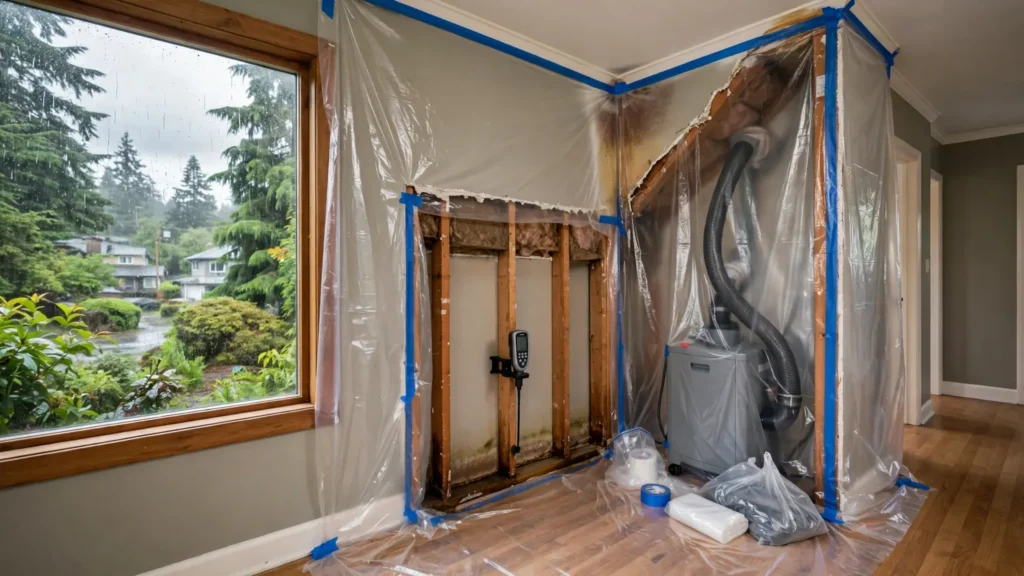
Professional remediation often uses polyethylene containment, negative-air machines with HEPA filtration, controlled demolition, bagging of porous debris, HEPA vacuuming, and detailed cleaning. Larger areas need a stronger separation from clean rooms so dust is not spread through the house during demolition.
The amount of containment should match the project. A tiny isolated surface problem does not require a whole-house setup, but a contractor removing several rooms of drywall should not treat the house as an open demolition site. Ask where the clean and dirty zones are, how debris leaves the house, whether HVAC returns are isolated, and how final cleaning is verified.
Oregon contractor licensing
Oregon law requires contractors performing construction activity for compensation to be licensed through the Oregon Construction Contractors Board. Mold remediation can overlap disaster restoration, demolition, drywall removal, carpentry, and other construction work, so homeowners should verify the contractor or business license that covers the proposed scope rather than relying on a generic “mold certified” statement.
The Oregon CCB provides public license verification. Ask for the company name and CCB number, then confirm active status before signing a contract. If the job includes electrical, plumbing, roofing, or other regulated trade work, those portions may also require appropriately licensed trade contractors.
Fix the moisture source before rebuilding
A remediation company can remove contaminated drywall or insulation, but the project will fail if the roof, window, plumbing, drainage, or ventilation problem remains. If water entered from the roof, compare the repair scope with the Home Cost Desk Roof Repair Cost 2026 guide. If the crawl space is driving humidity or wood moisture, use the Crawl Space Encapsulation Cost 2026 guide to budget the separate moisture-control work.
Keep remediation and source repair visible as separate line items. A contractor may handle both, but the homeowner should still know which dollars are paying for containment and cleanup and which are paying for the roof, plumbing, drainage, or envelope repair.
Attic mold in Portland
Attic mold often points to one of four issues: roof leakage, bath or kitchen exhaust terminating in the attic, air leakage from the house into the attic, or inadequate roof ventilation. Cleaning the sheathing without correcting the source can produce a temporary cosmetic improvement while moisture returns the next winter.
A strong attic quote identifies the source, contaminated square footage, insulation that must be removed, wood that can be cleaned versus replaced, ventilation changes, and how the attic will be dried before new insulation is installed. If the attic insulation is old or compressed, coordinate remediation with any insulation upgrade rather than paying twice for access and cleanup.
Crawl spaces and basements
Crawl-space mold can be driven by exposed soil, groundwater, drainage, pipe leaks, or humid outside air. Do not treat black staining on wood as proof of structural decay without an assessment, but do take persistent moisture seriously. Long-term dampness can damage subflooring, joists, beams, and insulation even when the visible mold area looks limited.
If bulk water enters the space, solve that first. A vapor barrier or encapsulation system works best after downspouts, grading, drainage, plumbing leaks, and sump requirements are understood. The French Drain Installation Cost 2026 guide can help budget drainage work when subsurface water is part of the cause.
Reconstruction can cost as much as remediation
Mold removal often ends with an empty wall cavity, missing flooring, removed insulation, or a partially opened ceiling. Some remediation companies rebuild; others stop after the area is clean and dry. Ask the contract to state exactly where their work ends.
Build-back costs can include drywall, texture, paint, trim, flooring, cabinets, insulation, tile, framing, and electrical or plumbing reconnection. A $2,000 remediation and a $6,000 all-in project may represent the same cleanup work plus very different restoration scopes. The homeowner should not compare those totals without separating the categories.
Insurance considerations
Homeowners insurance coverage depends on the cause of the water event and the policy language. Sudden accidental water damage may be treated differently from chronic seepage, long-term roof neglect, flooding, or persistent high humidity. Mold sublimits or exclusions can also apply.
If a recent covered event may be involved, contact the insurer promptly and ask what documentation is required before demolition. Photograph affected areas, water sources, damaged finishes, and the sequence of work when it is safe to do so. Do not delay emergency drying simply to preserve evidence, but keep a clear record of what was removed and why.
How to compare Portland mold-remediation quotes
Ask at least two qualified firms to price the same defined area and outcome. A proposal that only treats visible staining is not equivalent to one that opens a wet wall, removes damaged insulation, repairs the leak and documents drying. Use the national mold remediation cost guide as a broader price reference, but make the contractor’s written scope the basis of your decision.
| Compare this item | What the written Portland quote should specify | Question to ask before approval |
|---|---|---|
| Diagnosis and work area | Rooms or cavities included, affected materials, inspection findings and moisture readings | What evidence supports these demolition boundaries, and what would trigger a change order? |
| Containment and occupant protection | Barrier locations, HVAC isolation, filtered equipment, debris route and room-access restrictions | Which areas will be unavailable, and how will clean rooms be protected? |
| Removal and cleaning | Porous materials removed, structural surfaces cleaned, disposal and final cleaning | Which materials are being replaced rather than coated or wiped? |
| Water-source correction | Whether roof, window, plumbing, drainage or exhaust repairs are included | Who owns the leak repair, and what happens if it is outside this contract? |
| Verification and rebuilding | Drying evidence, inspection or independent clearance if warranted, drywall/insulation/paint exclusions | Who signs off before cavities are closed, and who pays for restoration? |
| Credentials and contingencies | Oregon CCB business identity, applicable trade qualifications, insurance and change-order process | Can I verify the license and see written unit prices or approval rules for hidden damage? |
A practical decision sequence for a wet-season Portland home
- Locate the moisture source first. Photograph the stain or damaged material without disturbing it, note any roof, plumbing or drainage event, and ask the assessor to document where water is entering. Do not enter unsafe, flooded or visibly damaged spaces.
- Define the affected footprint. Have each bidder distinguish visible growth from suspected concealed damage. Ask what additional inspection would justify opening a wall, ceiling or crawl-space assembly.
- Separate three budgets. Record remediation, moisture-source repair and rebuilding on different lines. An attic cleanup without a corrected bath-fan exhaust or roof leak is not a complete solution.
- Check the Oregon contractor record. Use the CCB’s official consumer license-check tools; verify the business name, active status, residential endorsement and applicable trade credentials before paying a deposit.
- Approve a measurable closeout. Request final photographs, evidence that affected materials are dry, documentation of the source repair and a written explanation of any verification test. Agree in advance who authorizes and pays for unexpected concealed damage.
Example: A lower-priced attic proposal may cover cleaning exposed sheathing only, while another includes removal of wet insulation, containment and coordination with a roofer. Neither bid is automatically better; first confirm the leak repair, safe access, material replacement and closeout are included somewhere in the total project budget.
Dehumidifiers, ventilation and indoor humidity
A dehumidifier can help control moisture after the building envelope and leak sources are corrected, but it should not be used to hide an active roof, plumbing, or foundation problem. In Portland, a basement or crawl space that stays damp through the wet season may benefit from dedicated humidity control once bulk water is managed. Ask where condensate drains, what humidity setpoint is recommended, and whether the unit can operate continuously without relying on buckets that must be emptied by hand.
Ventilation also needs context. More outside air is not automatically better if outdoor air is cool and wet and the building cannot dry. Bathrooms and kitchens need exhaust to the exterior; attics need a ventilation strategy that matches the roof assembly; and crawl spaces need either an approved vented or sealed approach. A remediation contractor should be willing to coordinate with HVAC or building-envelope professionals rather than treating every moisture problem as a cleaning problem.
Asbestos, lead paint and older Portland homes
Before a mold crew cuts drywall, removes old flooring or opens a ceiling, establish whether the materials need separate hazardous-material assessment. Oregon’s Department of Environmental Quality says residential buildings constructed before January 1, 2004 generally require an asbestos survey by an accredited inspector before renovation or demolition, subject to specified exceptions such as owner-occupants doing their own single-family renovation. A hired mold contractor should not assume that a small cleanup job automatically avoids these rules. See Oregon DEQ’s asbestos survey guidance for the scope and exceptions.
Painted surfaces in pre-1978 homes can also trigger lead-safe renovation requirements when disturbed. Ask bidders which wall, ceiling, insulation or flooring materials they plan to remove; who will arrange any required asbestos survey or lead-safe work; whether abatement is excluded from the quoted price; and who will provide clearance or disposal records. Mold cleanup and regulated asbestos or lead work are distinct scopes. Do not cut, sand or sample suspected hazardous materials yourself merely to obtain a cheaper mold quote.
Post-remediation verification and homeowner closeout
The end of the project should be more than a visual statement that the room “looks clean.” The work area should be dry, the moisture source should be corrected, debris should be removed, and the homeowner should understand which materials were cleaned, removed, or replaced. For larger jobs, independent post-remediation verification can provide additional confidence before expensive reconstruction covers the area again.
Request final photographs, moisture readings, equipment logs when relevant, disposal documentation, invoices for source repair, and written warranty terms. If a wall or attic is being closed immediately after remediation, confirm that the area has actually reached an appropriate dry condition first. These records are valuable during resale and if the same area develops moisture again.
Bottom line
Portland mold remediation in 2026 commonly falls around $1,013 to $2,174, averaging roughly $1,593, but attic, crawl-space, HVAC, wall, and whole-house projects can cost much more. The local climate makes moisture-source diagnosis especially important.
The best project removes contaminated material safely, verifies the building is dry, uses properly licensed contractors for the work being performed, and fixes the roof, plumbing, drainage, or ventilation problem that allowed mold to grow. Paying for cleanup without moisture control is the expensive version of doing the same job twice.
Frequently asked questions
How much does mold remediation cost in Portland in 2026?
A useful local planning range is about $1,013 to $2,174, with an average near $1,593. Larger attic, crawl-space, HVAC, wall, or whole-house projects can cost much more.
Do Portland mold contractors need a license?
Oregon requires contractors performing construction activity for compensation to be licensed through the Construction Contractors Board. Verify the specific license and scope before hiring.
Is mold testing always necessary?
No. Visible mold with a known moisture source may not require extensive testing. Testing is more useful when the source or extent is unclear, independent documentation is needed, or post-remediation verification is appropriate.
Why does attic mold return after cleaning?
Because the moisture source was not fixed. Roof leakage, exhaust ducts, air leakage from the house, or ventilation problems can keep the sheathing wet.
Does insurance cover mold remediation?
Sometimes. Coverage depends on the cause of the water damage and policy language. Sudden covered events may be treated differently from long-term seepage, maintenance issues, or flooding.
What should a Portland mold quote include?
The affected area and moisture evidence, containment, demolition and disposal, cleaning and drying methods, source-repair responsibility, final verification, reconstruction exclusions, contractor-license information and written change-order rules. Ask which costs would change if hidden wet insulation or damaged framing is discovered.
Can I clean a small patch of mold myself?
Sometimes. The EPA’s homeowner guidance says areas smaller than about 10 square feet may often be handled by the homeowner following appropriate precautions. This is guidance, not a guarantee of safety or a legal cutoff. Seek qualified help for extensive or concealed damage, sewage-contaminated water, suspected HVAC contamination or vulnerable occupants; consult a health professional if exposure raises medical concerns. Correct the moisture source regardless of who cleans.
Should I rebuild a wall immediately after mold removal?
Not until the water source is fixed and the affected cavity is adequately dry. Request the contractor’s documented drying findings and clarify whether independent verification is warranted before insulation and drywall conceal the area. If asbestos or lead-related work is implicated, complete the applicable assessment and compliance steps first.