2026 cost snapshot
| Item | Planning range / amount | Basis |
|---|---|---|
| National window project average | About $7,348 | Angi 2026 |
| National typical project range | $3,436–$11,838 | Angi 2026 |
| Typical individual window | $300–$2,500 | Angi 2026 |
| 10–12 standard windows | About $7,000–$9,000 | Angi national planning range |
| Las Vegas modeled city average | About $9,500 | Project Pricer 2026 local adjustment |
Quick answer
Las Vegas homeowners replacing windows in 2026 can use about $7,348 as a national average project benchmark, with many projects between $3,436 and $11,838. A modeled city-adjusted estimate places a typical Las Vegas project around $9,500. Individual installed windows commonly range from a few hundred dollars to $2,500 depending on frame, glass, size, style, floor level and whether the opening needs full-frame work.
Las Vegas adds a strong climate reason to pay attention to glass and frame performance. National Weather Service climate normals show a hot desert environment that has become warmer over recent decades. Solar gain, west-facing glass, air leakage, frame conductivity and installation quality can materially affect comfort even when the window technically meets minimum code.
What drives Las Vegas window cost
Window count is only the starting point. Frame material, glass package, operation style, exterior finish, size, custom shapes, structural repairs, stucco disturbance, upper-story access, interior trim, disposal and permit requirements all change the price.
A homeowner replacing ten standard vinyl windows in sound openings is buying a different project from one replacing large aluminum sliders embedded in stucco with water damage or structural modifications.
Low-E glass and solar heat gain
In the Las Vegas climate, Low-E coatings and solar-heat-gain performance deserve careful attention. A very low U-factor is useful, but the window also has to manage intense solar radiation. The ideal glass package can differ by orientation; west- and south-facing windows may benefit from stronger solar control.
Ask for the NFRC-rated U-factor and solar heat gain coefficient for the exact glass package. Avoid buying only from vague labels such as ‘energy efficient’ or ‘desert glass.’
Frame choices in desert heat
Vinyl is common because it is relatively affordable and low maintenance, but quality and reinforcement vary. Fiberglass is dimensionally stable and can perform well under temperature swings, though it usually costs more. Aluminum is strong and slim but conducts heat readily unless it includes effective thermal breaks.
Wood and clad-wood can provide premium appearance but require more maintenance and careful detailing. The Best Replacement Windows 2026 guide compares frame materials and performance tradeoffs in more detail.
Retrofit versus full-frame replacement
Retrofit or insert replacement keeps more of the existing frame and can be faster and less disruptive when the original frame is sound. Full-frame replacement removes the unit back to the rough opening and is better when the frame is damaged, poorly flashed, leaking or structurally compromised.
Angi’s national 2026 data places retrofit installation at roughly $100 to $300 per window in some scopes and full-frame work around $180 to $1,500 per window before the complete window package and site-specific costs. Ask the contractor exactly what remains in place.
Stucco and exterior finish risk
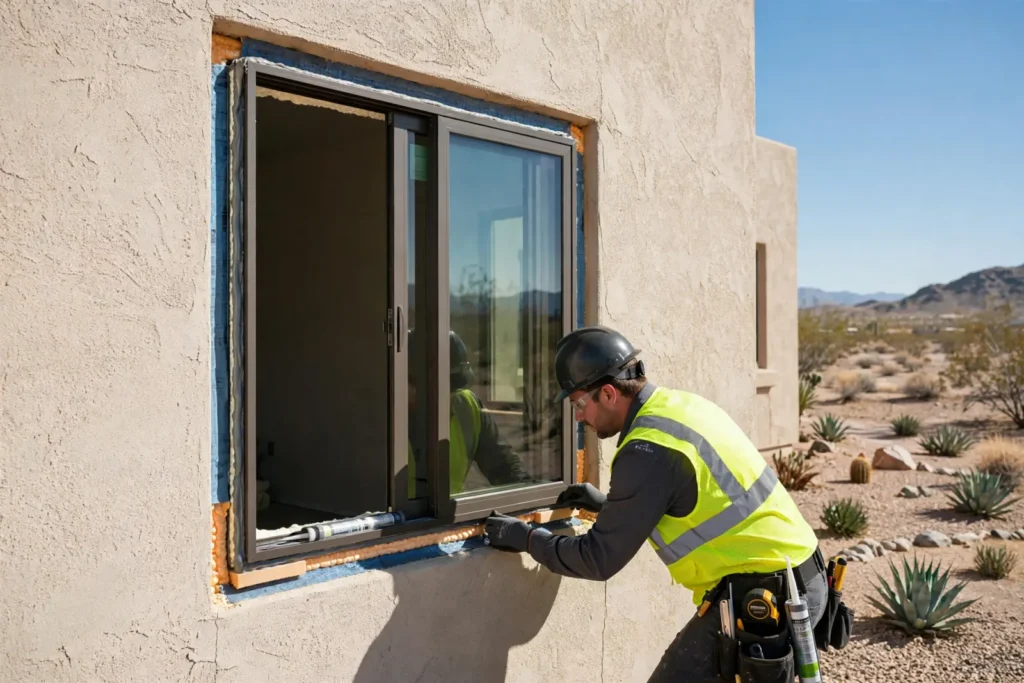
Many Las Vegas homes have stucco exteriors. Full-frame replacement can disturb the stucco return or weather barrier, so the contract should explain how the opening will be flashed, sealed and cosmetically restored.
A low bid may rely on surface caulk where a more complete flashing detail is needed. Ask for the water-management approach, not just the brand of sealant.
Permits and 2026 code context
The City of Las Vegas directs homeowners to verify whether a permit is required and distinguishes work that can be permitted without plans from work requiring plan review. The city also adopted updated 2024 building codes effective in 2026. Clark County has its own jurisdiction and permit rules, so the first step is confirming whether the property is inside City of Las Vegas jurisdiction or unincorporated Clark County.
Window replacement is not listed among the city’s simple no-plan permit items in the same way as some HVAC or plumbing change-outs, so do not assume every replacement is permit-free. Ask the contractor to identify the applicable city/county pathway for the specific scope, especially when openings are enlarged, structural framing changes, or energy-code compliance is involved.
Glass-only repair versus full window replacement
If the frame operates well and only the insulated glass unit has failed, glass replacement can be much cheaper than replacing the entire window. Angi’s 2026 national data puts standard double-pane glass replacement in the low hundreds for many windows.
Use the Window Glass Replacement Cost 2026 guide to compare that option with complete replacement. The Window Repair vs. Replacement 2026 guide can help when frames, seals and hardware are still serviceable.
Three Las Vegas project scenarios
Scenario 1 — standard retrofit vinyl package: ten similar windows, sound frames, first-floor access, straightforward interior trim. This is the type of project most likely to track normal whole-house averages.
Scenario 2 — premium fiberglass and solar-control glass: the homeowner prioritizes comfort and long ownership, uses upgraded Low-E glass and higher-performance frames. Material cost rises, but installation scope remains manageable.
Scenario 3 — full-frame stucco replacement: old aluminum windows leak air and water, some frames are damaged, and the stucco returns must be opened and restored. The project can exceed simple per-window averages because it includes envelope repair.
How to compare Las Vegas window quotes
Ask every bidder to price the same window schedule: label each opening by room and orientation (for example, west-facing living room slider versus shaded north bedroom), then record the manufacturer, exact model, operation type, frame, glass package and installation method for that opening. Require the NFRC-rated U-factor, solar heat gain coefficient (SHGC) and visible transmittance (VT) for the proposed configuration. A lower SHGC limits solar heat entering the home, but also compare daylight and appearance rather than assuming the lowest number is always the right choice.
| Quote item | What the Las Vegas homeowner should verify | Common gap to resolve in writing |
|---|---|---|
| Window schedule and ratings | Room, size, opening style, model, NFRC U-factor, SHGC and VT; note hot west-facing exposures | A generic “Low-E upgrade” without the actual glass specification |
| Retrofit or full-frame scope | Which existing frame components stay, how clear opening dimensions change and how hidden damage is handled | One quote assumes inserts while another removes and rebuilds the opening |
| Stucco and water management | Flashing/weather-barrier tie-in, exterior seal, stucco texture and color restoration | Patch or repaint excluded after a full-frame installation |
| Safety and approvals | Safety glazing, bedroom escape opening where applicable, permit authority and HOA sign-off | Required changes discovered after custom units are ordered |
| Completion and protection | Old-window disposal, interior protection, screen/lock operation, final inspection, labor warranty and payment milestones | Unspecified cleanup, inspection or return visit |
Five decisions before accepting a window bid
- Mark problem openings: photograph each window and record whether the complaint is heat, glare, drafts, failed glass, noise or water entry. Do not replace a sound frame solely because one glass unit has failed.
- Compare like for like: obtain itemized proposals for the same count and sizes, and ask each contractor to identify any opening that needs full-frame rather than insert work.
- Check the desert exposure: request exact NFRC performance values for exposed west- and south-facing windows and ask to see a glass sample in daylight before selecting tint or reflectance.
- Resolve the envelope work: for stucco openings, require written flashing, water-barrier and finish-restoration details, plus a change-order process for concealed damage.
- Confirm approvals and handover: verify the correct city/county authority and HOA requirements before fabrication; reserve final acceptance until every sash, lock, screen, drainage path and finish has been checked.
Example: Bid A and Bid B both promise ten Low-E windows. Bid A keeps the old frames and excludes stucco repair; Bid B includes full-frame removal, flashing and finish restoration. The totals are not directly comparable until the homeowner confirms which openings actually require each method and asks for the missing line items. This is a scope comparison, not a claim that one method is always better.
Compare the local bid with the Home Cost Desk Window Replacement Cost 2026 guide but keep climate-specific performance in mind. A cheaper clear-glass window may be a poor value on a west-facing Las Vegas wall.
- Confirm city versus Clark County jurisdiction.
- Ask whether the quote is retrofit or full-frame.
- Get NFRC performance values for the exact glass package.
- Separate stucco repair from window installation.
- Ask how the opening is flashed and air-sealed.
- Check labor warranty separately from manufacturer warranty.
- Do not pay a premium for vague ‘energy package’ marketing without ratings.
Timing and installation quality
Window replacement can be done year-round, but extreme summer heat makes interior comfort and worker exposure more challenging. Planned shoulder-season work may make it easier to keep openings uncovered for short periods.
Installation quality matters as much as glass specification. A high-performance window installed out of square, poorly flashed or inadequately air-sealed will not deliver its rated performance.
Orientation matters more in Las Vegas than a generic window schedule suggests
A north-facing shaded window and a large west-facing window do not experience the same solar load. If the manufacturer offers multiple Low-E coatings, ask whether the contractor is using one glass package everywhere for convenience or selecting based on orientation and appearance.
Very aggressive solar-control glass can change visible light and exterior reflectance. Review samples in daylight before ordering an entire house.
Air leakage and dust control
Desert dust makes air leakage noticeable. A new window should be installed with a continuous air seal at the opening, not just exterior cosmetic caulk. Ask how gaps around the frame are insulated and sealed before trim is replaced.
If dust appears at the frame after windy conditions, investigate installation and weep paths rather than assuming every speck is coming through the glass seal.
Stucco patch color and texture matching
Full-frame replacement can expose old stucco, lath or weather-resistive barrier. Matching the existing texture and aged color can be difficult, especially on a sun-faded elevation. Ask whether the window contractor performs stucco work directly or uses a separate trade.
Consider whether a broader wall repaint is needed after multiple full-frame replacements. That cost may not appear in the window proposal but can affect the finished appearance.
Tempered glass and safety locations
Windows near doors, tubs, showers, stairs or floors can require safety glazing depending on location and dimensions. If an old window does not meet current safety-glazing rules, replacement may need tempered or other compliant glass.
Ask the contractor to identify any safety-glazing locations before ordering. Discovering this after fabrication can delay the project and change price.
Sound, heat and visible-light tradeoffs
Las Vegas homeowners sometimes want both solar control and noise reduction. Laminated glass, asymmetric pane thickness and specialty packages can help with sound, but they increase cost and weight. Triple-pane windows may improve thermal performance but are not automatically the best value in every desert application.
Define the primary problem—heat, glare, noise, air leakage or condensation—before paying for upgrades. One glass package rarely maximizes every performance metric at the lowest cost.
Prepare the home before the installation crew arrives
Confirm which rooms will be opened each day, especially if work is scheduled during extreme heat. Move furniture and window coverings clear of the openings, protect flooring from glass and stucco dust, and ask the installer how exposed rooms will be secured if work runs past the planned day. Keep children and pets away from removal and cutting areas.
Before demolition, photograph existing stucco cracks, interior trim and any signs of water damage. Agree in writing who authorizes and prices hidden framing or moisture repairs; a surprise change order should describe the condition and proposed fix before work continues. Keep the window schedule and approved product specifications available for the final walk-through.
HOA approval and exterior appearance
Many Las Vegas neighborhoods have homeowner associations that regulate exterior colors, frame profiles, grid patterns, or visible changes from the street. HOA approval is separate from city or county permitting. A contractor can install a code-compliant window that still violates an association’s architectural rules if the homeowner does not obtain required approval.
Before ordering custom windows, check the association documents and obtain written approval when required. Replacement windows are often nonreturnable once fabricated, so discovering a color or grid restriction after delivery can be expensive.
Shading can sometimes outperform a premium glass upgrade
Exterior shade can reduce solar heat before it reaches the glass. Deep overhangs, properly placed awnings, shade screens, and landscape shading can improve comfort on intensely exposed windows. Interior blinds reduce glare but allow much of the solar energy to enter the building before it is blocked.
This does not mean window upgrades are unnecessary. It means homeowners should diagnose the comfort problem. Where windows are already failing, combine an appropriate Low-E package with shading rather than expecting glass alone to solve every west-facing heat problem.
Cooling-load changes after a whole-house window project
Replacing many old leaky windows can reduce infiltration and solar heat gain. The improvement may affect the home’s cooling load, especially if the old windows were single-pane or poorly sealed. Do not automatically downsize the air conditioner without a proper load calculation, but recognize that envelope improvements can change HVAC needs.
If a major HVAC replacement is also planned, coordinate the sequence so the HVAC contractor knows the final window specifications. The HVAC Replacement Cost 2026 guide explains why load and duct conditions matter when selecting equipment.
Large windows, safety glazing and bedroom egress
Large fixed windows and sliders can cost much more than standard bedroom windows because glass area, frame reinforcement, lifting equipment, and structural support increase. If an opening is widened or converted to a different configuration, framing and permits become more important.
Windows near doors, tubs, showers, stairs, or floors can require safety glazing depending on dimensions and location. Bedroom replacement windows may also need to preserve emergency escape and rescue dimensions. A thick insert frame can reduce the clear opening even when the replacement fits the old frame.
Ask the contractor to identify any tempered-glass or egress locations before ordering. Discovering a compliance issue after fabrication can delay the project and raise cost.
Financing, sales pressure and warranty fine print
Window companies often sell through in-home presentations with same-day discounts, financing promotions, and large percentage markdowns from a high initial price. Compare the final installed cash price, financing amount, interest cost, and exact product specification rather than the claimed discount percentage.
Read whether the warranty covers glass seal failure, frame warping, hardware, exterior finish, labor, and transfer to a future owner. Ask specifically about intense sun exposure and installation-related water or air leakage. A long product warranty does not replace a strong labor warranty from the installer.
Post-installation inspection
Operate every sash and lock before the crew leaves. Check that windows are square, screens fit, drainage openings are clear, sealant is continuous, and trim is complete. Photograph each finished opening.
After the first strong wind or wind-driven rain event, inspect for dust or water intrusion. Early warranty issues are easier to address when the installation record is fresh.
Bottom line
Las Vegas window projects in 2026 often fall within the national $3,436 to $11,838 range, with a national average near $7,348 and a city-adjusted planning midpoint around $9,500. The actual total depends on window count, frame, glass, stucco, access and replacement method.
In the desert climate, compare solar control, frame performance and installation detail—not just price per window.
Frequently asked questions
How much does window replacement cost in Las Vegas in 2026?
A city-adjusted planning midpoint is around $9,500 for a project, while national data shows many projects between about $3,436 and $11,838. Individual windows vary widely by size, frame and glass.
What glass is best for Las Vegas heat?
Low-E insulated glass with an appropriate solar heat gain coefficient is usually worth comparing. The exact choice depends on orientation, shading and the home’s comfort goals.
Are vinyl windows good in Las Vegas?
Quality vinyl can be cost-effective and low maintenance, but frame construction, reinforcement, color, exposure and installation quality matter. Fiberglass and thermally broken alternatives can offer different performance benefits.
Do replacement windows need a permit in Las Vegas?
It depends on jurisdiction and scope. Confirm whether the property is in the City of Las Vegas or Clark County and ask the contractor to identify the current permit path, especially for full-frame or structural changes.
Can I replace only the glass?
Yes, when the frame and operating hardware are sound and the failure is limited to the glass unit. Glass-only replacement can be much cheaper than a full window.
What should I compare besides price?
Compare installation method, frame material, NFRC U-factor, solar heat gain coefficient, flashing, air sealing, stucco repair, permit responsibility and both labor and product warranties.