2026 cost snapshot
| Item | Planning range / amount | Basis |
|---|---|---|
| Typical Chicago waterproofing | $745-$3,453 | Angi local 2026 range |
| Chicago average | About $2,037 | Angi local average |
| Planning cost per sq. ft. | $3-$10 | Angi local/national data |
| Chicago sump pump | $700-$1,350 | Angi local method range |
| Full interior or exterior systems | Request a site-specific written bid | Not represented by the small-project local average; scope and access drive cost |
Quick answer
Angi’s Chicago cost guide, labeled 2026 but updated in October 2025, reports a $2,037 average and a $745–$3,453 common range for a mix of waterproofing projects. That range covers a large number of interior crack, coating, drainage, and sump-pump jobs, but it should not be treated as the price of every serious water problem. A full interior perimeter drain, multiple sump pumps, exterior excavation, structural crack repair, sewer-backup protection, or a finished-basement rebuild can move the budget into the high four figures or five figures.
Chicago also needs a local flooding lens. The City Department of Water Management explains that intense localized storms can overwhelm sewers, pushing water toward private basement drains. Water can also enter through foundation cracks, window wells, walls, or the joint where the slab meets the foundation. The first step is therefore identifying whether the problem is groundwater, surface water, sewer backup, plumbing, or a combination.
2026 Chicago cost snapshot
Angi’s Chicago page, labeled “2026 Data” but last updated October 24, 2025, reports an average of about $2,037 and a common range of $745 to $3,453. Its $3–$10-per-square-foot planning figure covers varied methods, not a guaranteed price for a full perimeter drain or excavation. Angi’s national guide, updated July 20, 2026, reports a broader $2,461–$8,204 typical range. These are published estimates drawn from different project mixes, not verified 2026 Chicago contractor bids. Get a written, site-specific scope before setting a budget.
The local average is useful only when the scope is clear. A single wall crack, an interior perimeter drain system, and exterior excavation to the footing are different projects. Compare the method, drainage path, pump capacity, demolition, permits, and restoration – not just the final price.
Why Chicago basements flood
The City of Chicago notes that increasingly intense storms can fill the sewer system faster than it can drain. When that happens, additional water can push back through private sewer connections and basement drains. The city also explains that roof runoff adds to the load, which is why properly directing downspouts away from the private sewer system can help reduce risk.
That is only one pathway. Surface water can collect beside the foundation because of grading, short downspouts, clogged gutters, or low spots. Groundwater can create hydrostatic pressure against walls or below the slab. Masonry cracks and window wells can leak. A foundation contractor should identify the dominant pathway before prescribing an expensive system.
Interior drain tile and sump systems
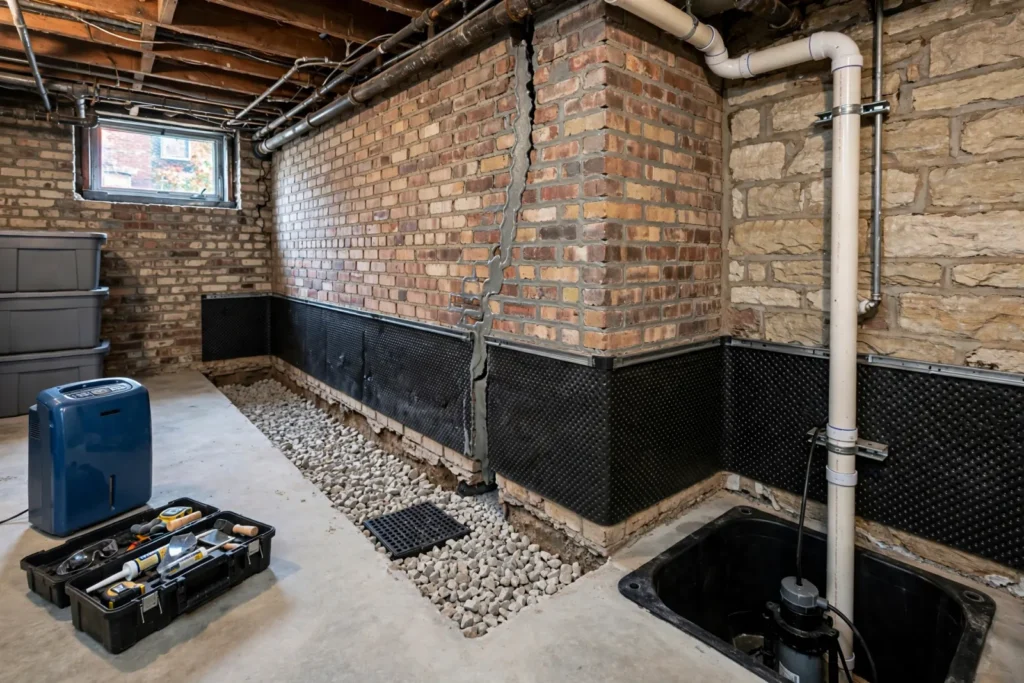
An interior perimeter drain system typically cuts a strip of the basement slab near the walls, installs drainage pipe and washed stone, routes water to a sump basin, and patches the concrete. This does not stop water from reaching the foundation exterior; it captures water after it enters the drainage plane and moves it to a pump before it reaches the finished basement.
The system can be highly effective when hydrostatic pressure is the main problem. Ask where the drain sits relative to the footing, how wall seepage is directed into it, what pump model is included, where discharge goes, and whether a battery backup or secondary pump is part of the design.
Sump pump cost and reliability
Angi local Chicago data places sump-pump installation around $700 to $1,350 for many standard projects. The pump itself is only part of the system. Basin size, check valve, discharge pipe, electrical supply, backup pump, alarm, and outside discharge location all matter.
Use the Home Cost Desk Sump Pump Replacement Cost 2026 guide to compare equipment and replacement costs. If the basement floods quickly during outages, a battery backup or water-powered backup may be worth discussing. Test the pump before the wet season and keep the discharge outlet clear.
Exterior waterproofing
Exterior work addresses water before it crosses the foundation. A contractor may excavate to the footing, repair cracks, apply a waterproof membrane or drainage board, replace footing drains, and backfill with appropriate material. This is usually more expensive because it requires substantial excavation and can disturb patios, sidewalks, decks, landscaping, or utilities.
Exterior work is attractive when the foundation wall itself needs repair or when interior systems would conflict with finished space. It is not automatically better for every house. The site, neighboring buildings, access, and the exact water source determine whether the higher cost is justified.
Cracks, masonry walls and older housing
Chicago has a large stock of older homes, and basement foundations may be brick, stone, concrete block, poured concrete, or combinations altered over time. A small nonstructural crack can sometimes be sealed or injected. A wall that is bowing, rotating, severely cracked, or losing mortar needs a structural assessment rather than a waterproof coating.
Use the Foundation Cracks 2026 guide to separate common warning signs from cosmetic cracking. Waterproofing should not be used to hide active structural movement.
Sewer backup is not the same as foundation seepage
Dirty water coming up from a floor drain or plumbing fixture during a storm points to a different problem than clear water entering through a wall. The City of Chicago has a separate “Water in Basement” service process for sewer backup. A backwater valve, overhead sewer, sewer repair, or other plumbing strategy may be relevant, but those systems require plumbing expertise and city rules.
Do not let a foundation waterproofing contractor sell wall coatings as a solution to sewer surcharge. Likewise, a backwater valve will not stop groundwater from entering a cracked foundation. Diagnose the pathway first.
Safety and reporting during an active basement flood
Keep people away from standing water if electrical equipment may be affected. Have a qualified electrician assess electrical hazards before cleanup; treat possible sewage backup as contaminated. The CDC provides flooded-home safety guidance. Chicago’s Water in Basement service is intended for suspected drain or sewer backup, not water entering through a window. Document the entry point and water depth from a safe location.
Gutters, downspouts and grading
Before paying for major interior work, inspect roof drainage. Chicago specifically encourages reducing stormwater entering the sewer system. Downspouts should move roof water away from the foundation and discharge where it can soak in or drain safely without flooding a neighbor.
Ground next to the house should generally slope away where site conditions allow. Window wells should drain and have covers where appropriate. These exterior basics do not fix every groundwater problem, but they are inexpensive compared with repairing a basement that repeatedly takes surface water.
Chicago permits
The City of Chicago Department of Buildings states that permits are required before most construction, demolition, and repair work. Sewer work has its own permit category, and projects involving excavation, new drainage, plumbing, or structural changes may need more than one approval.
Angi local data suggests many waterproofing projects with excavation or plumbing include permit costs in the hundreds of dollars, but the city fee schedule and exact scope control the real amount. Ask the contractor to identify each permit, who pulls it, and whether inspections are included. Do not rely on a flat national permit allowance.
Mold and finished-basement damage
A wet basement can damage drywall, flooring, insulation, framing, furniture, and stored belongings. Waterproofing the source does not automatically restore those materials. If mold has developed, remediation may need to occur before reconstruction.
Use the Mold Remediation Cost 2026 guide for that separate scope and the Basement Remodel Cost 2026 guide if a finished basement needs major rebuild work. Keep water-control costs separate from cosmetic restoration.
Three Chicago project scenarios
Scenario 1 – isolated seepage at one wall: downspouts and grading are corrected, a small foundation crack is repaired, and limited interior sealing is needed. This type of project can stay near the low end of the local range.
Scenario 2 – recurring groundwater at the cove joint: the basement takes on clear water during prolonged rain, so the contractor installs an interior perimeter drain and sump system. The project is larger than simple crack repair but may still be less disruptive than full exterior excavation.
Scenario 3 – finished basement with sewer backup and wall seepage: the homeowner needs plumbing work for backup protection plus foundation drainage and significant reconstruction. The total can move far beyond the local average because it combines multiple systems and trades.
How to compare Chicago waterproofing bids
Ask each bidder to document the observed water pathway before recommending equipment. An interior drain proposal for groundwater is not interchangeable with a plumber’s proposal to prevent sewer backup. Use the Home Cost Desk Basement Waterproofing Cost 2026 guide for broader method and budget context, then compare the actual Chicago scopes line by line.
| Quote item | What a comparable written bid should specify | Chicago homeowner’s decision check |
|---|---|---|
| Water-source diagnosis | Entry locations, evidence, whether the issue is wall seepage, surface runoff, sewer backup, or more than one source | Does the proposed work actually address the water seen during the last storm? |
| Interior drain tile | Linear feet, slab removal and replacement, wall-to-drain detail, cleanouts, sump basin and discharge route | Which walls are covered, and where will collected water go? |
| Pump and backup | Primary pump model, capacity at installed lift height, electrical work, check valve, alarm, backup power and testing | What happens if a storm coincides with an outage or a blocked outlet? |
| Exterior work | Excavation length and depth, access, utility locating, membrane or drain board, backfill and surface restoration | Are sidewalks, landscaping, neighboring property and hidden conditions addressed? |
| Sewer-backup work | Licensed plumbing scope, protected fixtures, valve or overhead-sewer design, access for maintenance | Does it address reverse flow through floor drains rather than groundwater seepage? |
| Permits and handover | Who confirms permits and inspections, disposal, change-order rules, test results and written warranty exclusions | What is excluded from the price and who pays for a failed inspection or extra restoration? |
Six steps before signing a waterproofing contract
- Record the last water event. Photograph where water first appeared, its approximate depth, which drains or walls were involved, and whether the event coincided with heavy rain or plumbing use. Do not enter unsafe standing water to gather evidence.
- Separate sewer backup from seepage. Water rising from a floor drain or toilet calls for a plumbing assessment; water entering at the wall-floor joint points toward foundation drainage. Mixed symptoms may require both specialists.
- Check roof runoff first. Inspect downspouts, clogged gutters, grading and window wells from a safe location. Chicago’s water department specifically discusses keeping roof runoff out of overloaded sewers; any discharge change must avoid creating a hazard for neighbors.
- Request matching, itemized scopes. Ask at least two qualified contractors to show drain lengths, pump and backup specifications, discharge location, excavation, permits, electrical work, slab repair and finished-room restoration separately.
- Confirm who is responsible for approvals and unexpected damage. Before work, ask the relevant city department about the proposed plumbing, sewer, excavation or structural scope. Require written authorization before additional repairs or demolition.
- Set acceptance criteria. Require a demonstrated pump-and-alarm test where applicable, discharge-path inspection, photos of concealed work, permit or inspection documentation when required, and clear instructions for maintenance and warranty claims.
Bid comparison example: One quote covers 60 linear feet of interior drain and a primary sump pump, but excludes the electrical outlet, backup pump and concrete-floor finish. A second quote includes those items and a documented discharge route. Even without assigning hypothetical dollar amounts, the second scope is broader. Ask the first contractor to price the missing items before deciding which is cheaper for the same outcome.
Backwater valves and overhead sewers
When storm-related sewer backup is part of the problem, Chicago homeowners may hear proposals for a backwater valve or an overhead-sewer configuration. These are plumbing solutions, not foundation coatings. A backwater valve is designed to prevent reverse flow under certain conditions, while an overhead sewer changes the way basement fixtures discharge so surcharged public sewers are less likely to send wastewater back into the house.
Both approaches require proper design, maintenance, and city-compliant plumbing work. A valve can fail if it is inaccessible or full of debris, and an overhead sewer can involve ejector pumps, new piping, and significant interior construction. Ask a licensed plumbing professional to explain which fixtures are protected, how the system behaves during a surcharge event, and what maintenance the homeowner must perform.
Battery backup, alarms and power outages
Chicago storms can coincide with power interruptions, which is exactly when a sump pump may be working hardest. A finished basement with a high inflow rate has more to lose from a dead pump than an unfinished storage basement. Battery backup, a second pump, a water-level alarm, or remote monitoring can be rational upgrades when the consequence of failure is high.
Ask the contractor for the pumping capacity at the actual lift height, not only the pump model name. The discharge pipe, check valve, and exterior outlet can limit performance. A backup system should be tested during handover so the homeowner knows which alarm is normal, how to silence it, and when the battery or pump needs service.
Waterproofing warranties: read the exclusions
Basement-waterproofing companies often advertise long or transferable warranties. Read what is actually covered. A warranty may apply only to water entering through the installed drain system and exclude plumbing leaks, sewer backup, foundation movement, window wells, power failure, clogged discharge lines, or exterior grading. That does not make the warranty worthless, but it changes what “lifetime” means.
Ask whether service visits have a fee, whether pump equipment has a separate shorter warranty, and whether the warranty transfers automatically to a buyer. Keep the original drawing showing drains and sump locations. Future owners or contractors will benefit from knowing exactly what system is hidden beneath the slab.
Bottom line
Angi’s published Chicago planning figures show a $2,037 average and a $745–$3,453 common range, based on a page labeled 2026 but updated in October 2025. Larger interior drainage, exterior excavation, structural repair, sewer-backup protection, and finished-basement restoration can cost much more.
The best Chicago waterproofing plan starts with the water pathway. Heavy-rain sewer surcharge, groundwater, surface runoff, plumbing, and wall cracks require different solutions. Pay for a diagnosis and a defined drainage path, not a generic promise that one coating or one pump will make every basement dry forever.
Frequently asked questions
How much does basement waterproofing cost in Chicago in 2026?
Many local projects fall between about $745 and $3,453, with an average near $2,037. Full drainage systems, exterior excavation, sewer-backup protection, and restoration can cost more.
Why do Chicago basements back up during heavy rain?
The City of Chicago explains that intense storms can fill the sewer system, causing water to surcharge through private sewer drains. Surface runoff and groundwater can also enter separately.
Is an interior drain tile system a real waterproofing method?
Yes. It manages water that reaches the foundation drainage plane and directs it to a sump. It does not stop all exterior water from reaching the wall, so the contractor should explain the intended pathway.
Do Chicago waterproofing projects need permits?
Many projects involving excavation, plumbing, sewer work, demolition, or structural changes do. The exact permits depend on scope, so verify with the city and contractor before work.
Will a sump pump stop sewer backup?
Not necessarily. A sump pump manages groundwater or drainage water. Sewer backup may require a backwater valve, overhead sewer, sewer repair, or another plumbing solution.
Should I waterproof before finishing a basement?
Yes. Recurring water should be solved and the space dried before new drywall, flooring, insulation, or cabinetry is installed.
Should I call a plumber or a basement waterproofing contractor first?
If water rises from a floor drain, toilet or shower during heavy rain, start with a qualified plumbing assessment and consider the city’s sewer-backup reporting process. If water appears along a foundation wall or the wall-floor joint, ask a foundation drainage specialist to investigate. When both occur, request separate diagnoses and a coordinated scope rather than assuming one waterproofing product fixes both.
What should I check before accepting a completed interior drain system?
Ask for photos of the concealed drain route, the sump and discharge layout, and a demonstration of the primary pump, backup and alarm if included. Confirm the permitted discharge location, concrete restoration, maintenance access, written warranty exclusions and any required inspection records before final payment.